Education Services
Take your career to the next level as an educator in Australia.
Teachers and childcare workers here enjoy generous entitlements. Both groups can earn attractive salaries, including paid sick leave and carers leave.
Teachers can also access professional development opportunities and support. Flexible work options and around 12 weeks of school holidays each year, make it even easier to enjoy the relaxed Australian lifestyle.

School Education

Early Childhood Education

Education Leadership

Special Education

Get priority visa processing
If you have an application in an occupation as a school teacher (including early childhood (pre-primary school) teacher), school principal, vocational education teacher, university lecturer, child care worker or child care centre manager, your skilled visa application will get priority processing if you are already in Australia when you apply. For more information and the full list of occupations, visit skilled visa processing priorities.
We encourage applicants diverse in gender, languages, ethnicity, age, sexual orientation and religious beliefs to work with us. Australian workplaces are inclusive and celebrate diversity and equity.
Teacher pay
Primary school teachers in Australia have a median weekly pay of AUD$2,000, while the figure is higher for secondary school teachers, at $2,166.
Accounting for inflation, lower-secondary teachers with 15 years’ experience saw their salaries grow 6% during the 8 years to 2023, compared with an average increase of 4% across OECD countries with available data.
< Click the cards for more information
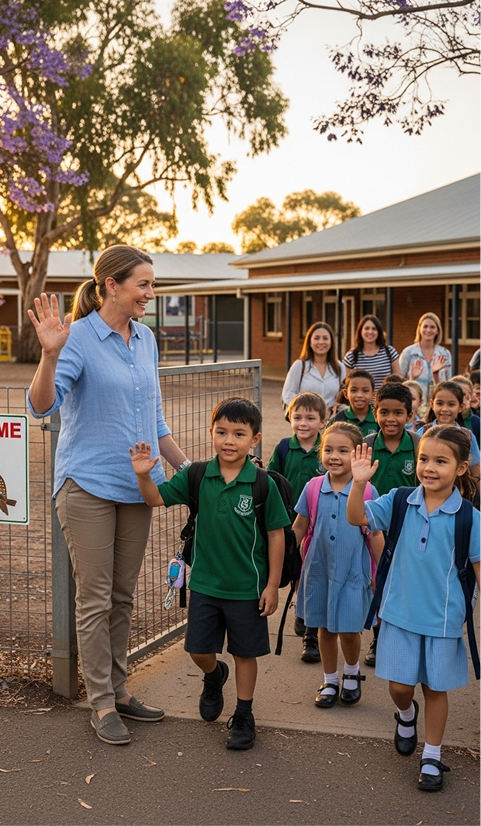
Bonuses for regional and remote teachers
If you work in a remote school, state and territory governments may offer you extra incentives such as:
- moving home allowance
- bonuses for working more than 12 months in a remote location
- subsidised housing
- additional personal and staff development days
- smaller class sizes
- travel and accommodation for specialist medical appointments
- remote living allowance.
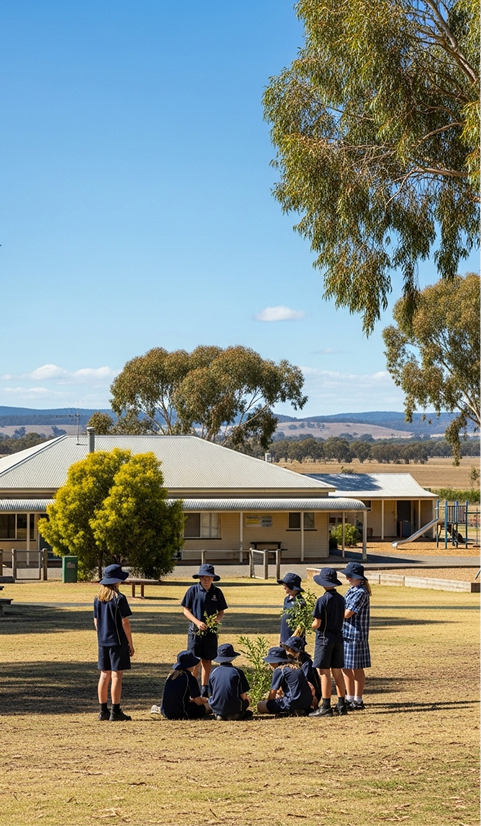
Nearly a third of teachers work in regional settings
Nearly a third of teachers work in rural, regional or remote settings. They educate more than a quarter of Australia’s students.
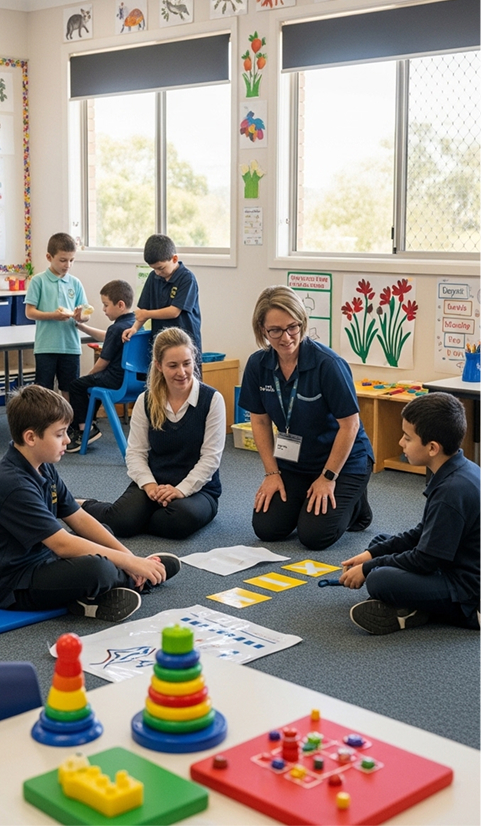
Australia invests above OECD average in education
We spend more on education - from primary to tertiary levels - than the OECD average as a portion of our economy.
Bonuses for regional and remote teachers
If you work in a remote school, state and territory governments may offer you extra incentives such as:
- moving home allowance
- bonuses for working more than 12 months in a remote location
- subsidised housing
- additional personal and staff development days
- smaller class sizes
- travel and accommodation for specialist medical appointments
- remote living allowance.
Nearly a third of teachers work in regional settings
Nearly a third of teachers work in rural, regional or remote settings. They educate more than a quarter of Australia’s students.
Australia invests above OECD average in education
We spend more on education - from primary to tertiary levels - than the OECD average as a portion of our economy.
Teaching opportunities and teacher registration
Explore teaching options across Australia’s public, Catholic and independent education sectors:
You will also need to apply for registration in the state or territory you want to teach.
Click the cards for more information >

Education sector distribution
Around 63% of students attend government schools, followed by almost 20% studying at Catholic schools and nearly 17% at independent schools.
4.1 million students across 9,650 schools
There were more than 4.1 million students enrolled in over 9,650 schools in Australia in 2024, according to the Australian Bureau of Statistics.
13 students to teacher ratio
The average student to teacher ratio* across all Australian schools was less than 13 students to one teacher.
* based on full-time equivalent student and teacher figures
Education sector distribution
Around 63% of students attend government schools, followed by almost 20% studying at Catholic schools and nearly 17% at independent schools.
4.1 million students across 9,650 schools
There were more than 4.1 million students enrolled in over 9,650 schools in Australia in 2024, according to the Australian Bureau of Statistics.
13 students to teacher ratio
The average student to teacher ratio* across all Australian schools was less than 13 students to one teacher.
* based on full-time equivalent student and teacher figures
Australian schooling
In Australia, teachers are employed by state and territory governments, as well as private education institutions, such as Catholic and independent schools.
Schools run by state and territory governments are often called public schools, state schools or government schools. Independent and Catholic schools are often called private schools or non-government schools.
Teachers in Australia are supported in their role through the Australian Curriculum. It outlines what all Australian students should be taught, no matter where they live or what school they go to.
To have your overseas teaching qualifications and English language ability recognised here, you must first be assessed by the Australian Institute for Teaching and School Leadership.
Read more about skills assessments for teachers.
Early childhood education and care (ECEC)
Early childhood education is an important part of Australia’s education system. It supports children’s learning and development from birth to school age.
There is high demand across Australia for experienced early childhood professionals.
From the inner city to our regions and remote communities, we offer a welcoming and rewarding environment to build a career in ECEC.





Early childhood professionals’ pay
Early childhood teachers in Australia earn a median weekly pay of AUD$1,660.
The median weekly pay for childcare centre managers is $1,412, and $1,146 for child carers. Over 50% of centre based day care workers were paid above the relevant award rate.
< Click the cards for more information

Bonuses and incentives
The Australian Government provides opportunities for:
- professional growth and development
- support for early childhood teachers in regional and remote areas
- mental health and wellbeing programs.

Incentives for ECEC workers in regional areas
States, territories and local councils may also offer incentives to attract ECEC workers to regional areas.

Strong work–life balance
People working in Australia’s ECEC sector can enjoy a great work-life balance, thanks to the variety of casual, part-time and full-time work options.
Bonuses and incentives
The Australian Government provides opportunities for:
- professional growth and development
- support for early childhood teachers in regional and remote areas
- mental health and wellbeing programs.
Incentives for ECEC workers in regional areas
States, territories and local councils may also offer incentives to attract ECEC workers to regional areas.
Strong work–life balance
People working in Australia’s ECEC sector can enjoy a great work-life balance, thanks to the variety of casual, part-time and full-time work options.
Australia’s ECEC landscape
Children can access early childhood education and care from birth to school age (usually around 5 years old).
In Australia, ECEC centres can be owned and run by state and territory governments, businesses, community organisations, charities, individuals, and schools.
There are different names for ECEC centres, such as, child care, day care (including long day care and occasional care), kindergarten (or kindy and kinder), early-learning, and pre-school.
Different states have different systems and wording. For example, ‘kindergarten’ in most states and territories means pre-school, but in New South Wales and the ACT, it is the first year of school.
Assessments
You must be qualified to work in early education and child care in Australia. To have your overseas qualifications and experience recognised here, you will need to be assessed first.
The Australian Children’s Education and Care Quality Authority (ACECQA) provides skills assessments for the following roles:
- Early childhood (pre-primary school) teacher
- Child care centre manager
- Child care worker (group leaders only).
Read more about skills assessments for early childhood teachers and child care workers.
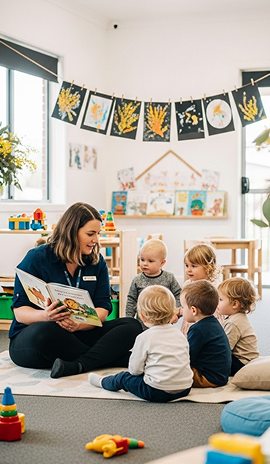



Explore your early childhood educator opportunities
Visit the Workforce Australia Online website and search for jobs using keywords such as educator, childhood, and childcare.
* Numbers are approximate

9,570 centre based day care facilities*
3,050 kindergarten/pre-school centres*

273,800 centre based day care workers*
28,000 pre-school workers*

1.5 million children in ECEC*

1:4 educator to child (birth to 24 months) ratio in centre-based day care*
Further reading
Learn more about the Australian education sector:
Australian Government Department of Education
Australian Institute for Teaching and School Leadership
Australian Children’s Education and Care Quality Authority (ACECQA).
Your expertise, your future.
Make the smart move to Australia
Keen to live and work in regional, rural, or remote Australia?
Check out Move To More website

If you long for a place that truly rewards your effort and talent, this is your destination. The inclusiveness of the society means no matter what family background you come from, what language you speak, everyone has a fair go.
Clara enjoys teaching and feels supported to further develop her skills as an educator. She is now studying for a Master of Learning Intervention to qualify as a special education teacher. As a recipient of a Commonwealth supported place, her university fees are subsidised by the Australian Government.
Based on her experience as a teacher in a government school, Clara said that school children in Australia are nurtured and well developed physically, mentally and academically.
Clara enjoys the multicultural aspects of life in Melbourne, including the wide variety of Chinese foods available so she can always get a taste of home from shops and restaurants. Besides work and study, Clara also finds time to pursue her interest in ballet dancing.
Clara Li from China
Common Questions
Can my partner or family migrate with me?
Yes. Many skilled visas allow you to bring immediate family members. Australia offers schooling, healthcare, and work rights for eligible dependents.
Discover more about family lifestyle in Australia
What visa options are available for working in Australia?
To work in Australia across key industries, several skilled visa options are available:
- Skilled Independent visa – subclass 189: For skilled workers coming independently to Australia. Points-tested and permanent.
- Skilled Nominated visa – subclass 190: For workers nominated by a state or territory. Points-tested and permanent.
- Employer Nomination Scheme – subclass 186: For skilled workers nominated by an Australian employer. Permanent visa.
- National Innovation visa – subclass 858: For individuals with internationally recognised talent in target sectors. Permanent visa.
- Skilled Work Regional visa – subclass 491: Provisional visa for skilled workers in regional areas with a pathway to permanent residency.
- Skills in Demand visa – subclass 482: Temporary visa for employer-sponsored skilled workers to fill labour shortages.
- Skilled Employer Sponsored Regional visa – subclass 494: Provisional visa for workers sponsored by regional employers, leading to permanent residency.
Are my skills in demand in Australia?
Many professions across industries like health, technology, construction, and education are in high demand due to Australia’s growing economy and national priorities. Checking the skilled occupation lists can help you understand where your skills fit.
Explore career pathways to find the best opportunities that match your skills.
Does Australia provide subsidised childcare?
Australia has a child care subsidy that is available to working parents. Find out more
What support is available for families of skilled migrants?
Australia offers a welcoming environment for skilled migrants and their families, with strong support systems to help you settle and thrive. Key benefits include:
- Excellent education system: access to world-class public and private schools, and leading universities.
- High-quality healthcare: comprehensive care provided by government through Medicare (for eligible visa subclasses), and private health services.
- Family-friendly work culture: flexible working arrangements, generous parental leave, and child care support.
- Safe and stable communities: a high standard of living with a strong economy and low crime rates.
- Job opportunities: diverse career prospects for both primary applicants and partners.
Learn more about family lifestyle